mastered vs developing · learning app skill levels
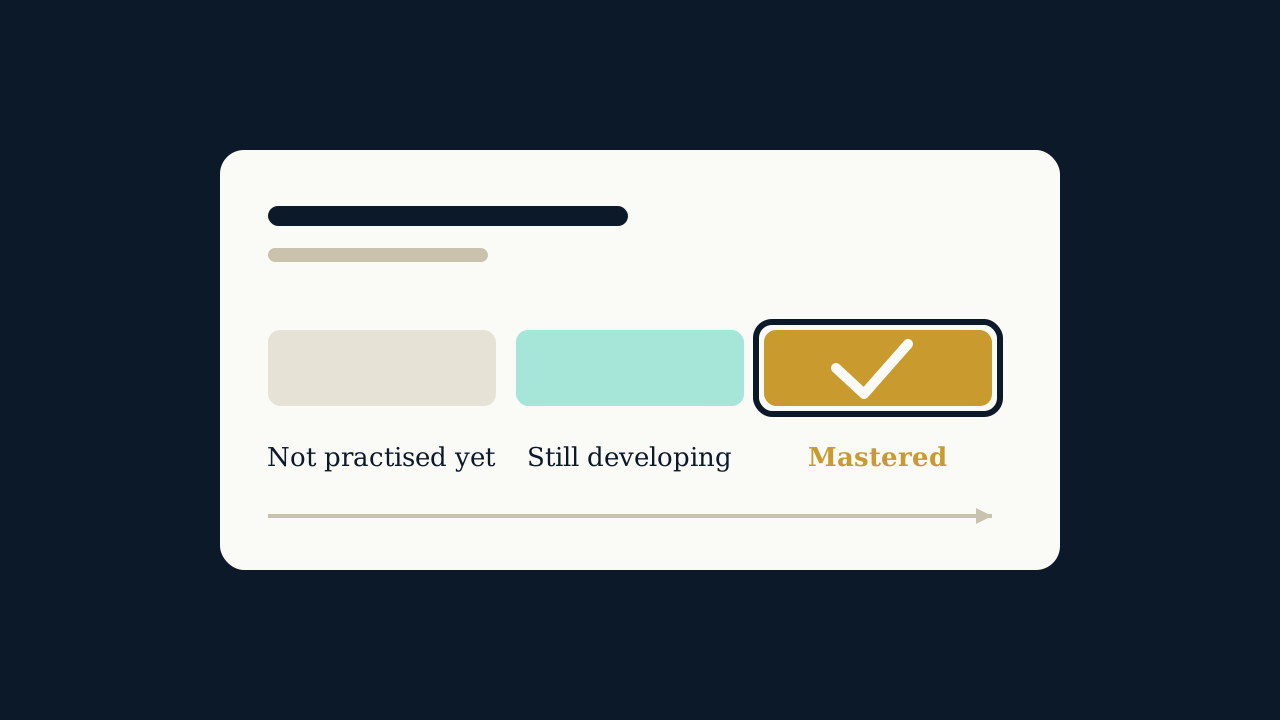
On a learning app or a report card, "mastered" and "developing" are not grades, they are skill levels. Mastered means your child can apply one specific skill reliably and on their own. Developing, often written "still developing", means the skill is forming but still wobbles. Neither is a final verdict. Both point to a next step rather than a score.
What does "mastered" vs "developing" mean on a learning app?
They describe how solid one skill is, not how the whole subject went. A grade like "Maths: B2" or "78%" blends a dozen skills into a single number. A level attaches to one skill at a time: your child might be mastered on multiplication facts, still developing on word problems, and untouched on a topic the class has not reached. That is the point of the vocabulary. It tells you which skill to work on, which an average never can.
Different tools slice this into a different number of levels, which is where the confusion starts. Some report cards use four bands, some learning apps use four or five, and India's new national card uses three. The words move around, but the idea underneath is the same: a ladder from "just starting" to "can do this independently".
Where do "mastered" and "developing" come from?
These labels come from standards-based assessment, where a child is judged against a skill rather than ranked against classmates. A common school version is a four-point proficiency scale: Beginning, Developing, Proficient, and Advanced. Instead of "Maths: B+", the card reads "Multiplying fractions: 3, Word problems: 2", so a parent can see exactly where the child is steady and where they are not.
The vocabulary shifts with the board, too. Cambridge writes its curriculum in Learning Objectives numbered by stage, which is why a report card can say Grade 4 while the scheme of work says Stage 4: our guide to Cambridge grades and stages maps the two. India's own report card uses the same logic with three levels. Under the CBSE Holistic Progress Card, a child is marked Beginner, Progressing, or Proficient on each competency, defined by how much help they still need. Learning apps borrowed the model too. Khan Academy, for example, moves a skill through Attempted, Familiar, Proficient, and Mastered as accuracy climbs from below 70% to a full pass on a mixed assessment (as of July 2026).
Proficient: achieves the competency and associated learning outcomes on his or her own.
That CBSE definition captures the whole idea in one line. The top level is not about a perfect score on one day. It is about doing the skill unaided.
What does "mastered" actually mean for your child?
Mastered means demonstrated, independent, and repeatable, not lucky once. Most mastery-based systems set the bar high on purpose: the research literature recommends a mastery threshold of 80 to 90% before a skill counts as secure, and apps like Khan Academy reserve "mastered" for a skill applied correctly on a later mixed test, not just the practice set where it was first learned.
Why so strict? Because the level is meant to predict what happens next. This idea traces to Benjamin Bloom's mastery learning, and it holds up: a 1990 meta-analysis of 36 studies found an average effect size of 0.59 for mastery-based approaches, a medium-to-large gain over ordinary teaching. When a system tells you a skill is mastered, it is claiming your child can carry it forward into the next chapter that depends on it. That is a stronger, and more useful, statement than "got 9 out of 10 on Tuesday".
What does "still developing" mean, and is it bad?
Still developing means the skill is on its way but not yet reliable, and it is the most useful label on the whole card. It is not a fail and not a diagnosis. It marks the exact spot where a little targeted practice changes the outcome, because the idea is already half-formed and just needs to firm up.
Read literally, "developing" is a status update, not a judgement. The CBSE scale even defines its middle level as achieving the skill "with occasional or some support", one step short of doing it alone. The mistake parents make is treating "developing" like a bad grade and pushing on the whole subject. The better move is narrow: find the single wobbling skill and practise that one, and it often tips to solid faster than a broad grade would suggest.
What about "not practised yet"?
There is a third state that gets lost when a tool only has "good" and "bad": the skill the class simply has not covered enough to judge. It deserves its own label, not a low score. LearnAlice calls it "not practised yet" and never counts it as a gap, because a skill with no evidence is a blank, not a weakness.
This matters because a system that forces every skill into a number will quietly log "no data" as a zero, and a page of zeros reads as a struggling child when it may only be an early one. Separating "not practised yet" from "still developing" keeps the picture honest: one says wait, the other says practise now.
Is "developing" the same as a low grade like C or 60%?
No. A grade and a level answer different questions. A grade like C or 60% averages performance across a whole subject on one test, so it hides which skills are fine and which are not. A level like "developing" attaches to a single skill, so it tells you exactly where to act. A child can score a comfortable 75% overall and still be "developing" on the two skills quietly dragging the number down.
National data shows why the averaged grade can mislead. The ASER 2024 report found only 30.7% of Std V children could solve a simple division problem. A term grade rarely surfaces a specific gap like that; a per-skill level is built to. If division is the skill you want to firm up, the Class 5 Maths worksheet topics let you generate practice for exactly that skill.
What should you do with a "developing" label?
Treat it as a to-do, not a report. Pick the one skill marked developing that matters most for what the class is doing next, give it short, regular practice, and recheck. Because the skill is already forming, a few focused sessions usually move it, and watching that same skill across several pieces of work tells you far more than one grade does. The habit of reading skills over grades is the heart of how to read your child's worksheet, and the three plain buckets behind it are laid out in how to read your child's CBSE report card.
This is the gap LearnAlice was built to close. It does not teach or tutor. It grades the worksheets your child already does and rolls them into a skill picture in three plain states, Mastered, Still developing, and Not practised yet, so a wall of numbers becomes one clear next thing to practise. If you want a starting point, the free worksheet library covers every CBSE class and subject, topic by topic.
FAQ
Does "mastered" mean my child is finished with a skill?
It means they can do that specific skill reliably and on their own right now, judged against a high bar, usually 80 to 90% on a fresh test rather than the practice set. It is not permanent. Skills fade without use, so a mastered skill can slip back to developing if it is left untouched for a long time.
Is "developing" a bad result on a report card?
No. Developing means the skill is forming but not yet consistent, one step short of doing it unaided. It is the most actionable label on the card, because it marks exactly where short, targeted practice pays off. It is a status, not a diagnosis, and never a substitute for a professional's view if you have a deeper concern.
Why do different apps and report cards use different level names?
Because each system designs its own scale, but they share one ladder: from "just starting" to "can do this independently". A four-point school scale (Beginning, Developing, Proficient, Advanced), CBSE's three-level card (Beginner, Progressing, Proficient), and an app's mastery track all describe the same journey with different words.
Want your child's own worksheets turned into these plain skill levels? Start a 14-day free trial of LearnAlice and see what is mastered, what is still developing, and what to practise next.
mastered vs developinglearning app skill levels
Worksheets are the input. Clarity is the output.
LearnAlice turns every worksheet your child completes into a clear picture of what they've mastered, what's still developing, and the one thing to practise next — in your school board's own language.
Start free trial14 days free per child · no card needed