CBSE competency based questions · CBSE · Parenting
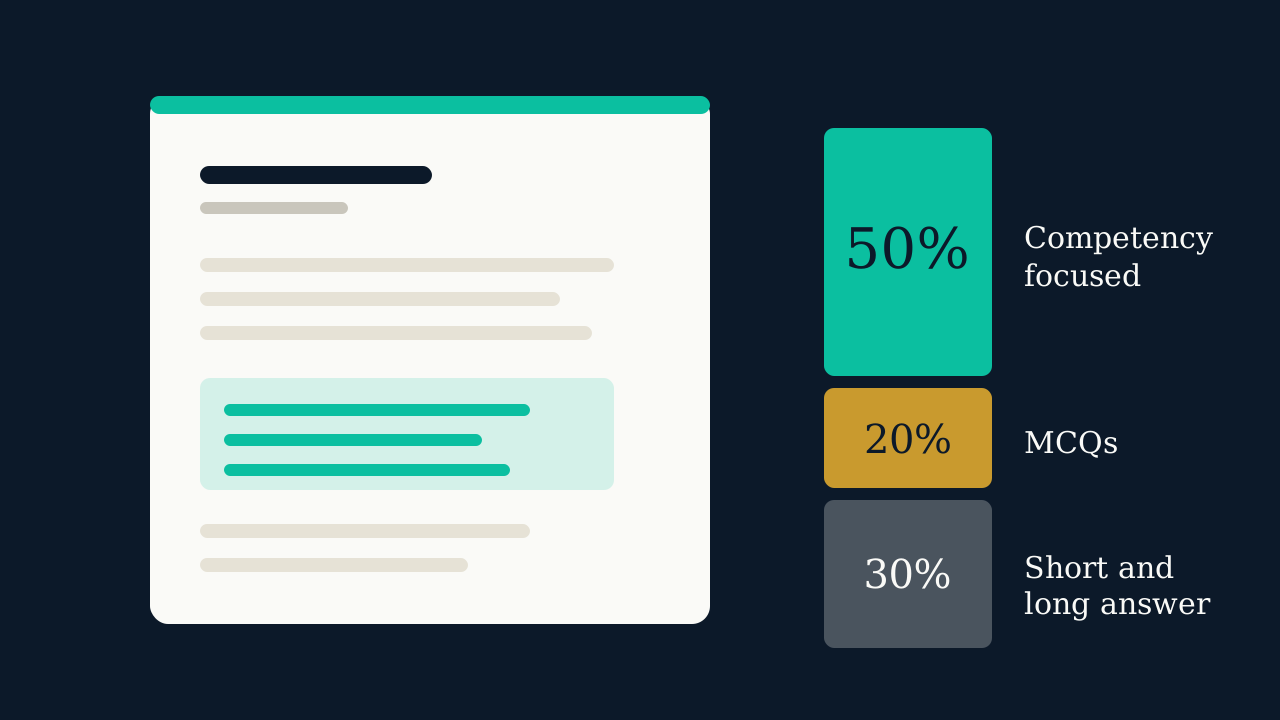
A competency based question asks a child to use what they know in a situation they have not seen before, rather than to recall it. CBSE now builds about half of every board theory paper from these questions: case-based, source-based, data interpretation and situational items. The share has been steady since 2024, and it is the reason "knows the chapter" no longer predicts the mark.
What is a competency based question?
It is a question that cannot be answered by remembering a line from the textbook. CBSE's own description lists the formats: case-based, source-based, integrated, data interpretation, situational and application-oriented items. The board's shorthand in its circulars is "competency focused questions", which is the phrase to look for in official documents.
A recall question asks for the formula for the area of a rectangle. A competency based question gives a floor plan with two rooms, one measurement missing, and asks how much tile to buy. The arithmetic is easier than the textbook exercise. The work is in deciding what to do.
That distinction is the whole point of the change. The curriculum document for 2026-27 puts it plainly:
Presently, approximately 50% of the questions are competency-focused: such as case-based, source-based, integrated, data interpretation, situational, and application-oriented. Remaining items include select-response (MCQs) and constructed-response (short- and long-answer) questions. This structure may be reviewed periodically. Source: Introduction to Secondary Curriculum Part 1, 2026-27, CBSE, section 3.1
How much of the CBSE paper is competency based?
Half of the theory paper, and the exact split is published. Circular Acad-30/2024 sets the composition of the year-end board and annual examination papers as follows.
| Question type | Classes IX and X | Classes XI and XII |
|---|---|---|
| Competency focused (case-based, source-based, integrated, other) | 50% | 50% |
| Select response (MCQs) | 20% | 20% |
| Constructed response (short and long answer) | 30% | 30% |
Source: Circular Acad-30/2024, Assessment and Evaluation Practices of the Board for the Session 2024-25, CBSE, 3 April 2024.
Two details parents routinely get wrong. First, these percentages apply to the theory paper only, which carries 80 marks in major subjects for Classes IX and X. The other 20 marks are internal assessment run by the school, and a student must clear 33% separately in each component.
Second, the scheme covers Classes IX to XII, not only the board years. Class IX sits the same paper design in a school-conducted annual examination, which is why the shift shows up a year before the board exam does.
Did the competency weightage stop rising?
Yes, for now, and this is where most explainers are out of date. For Classes IX and X the 50% figure was already in force in 2023-24, and Acad-30/2024 explicitly recorded "no change from previous academic session" for 2024-25. The move that year was in Classes XI and XII, where competency focused questions rose from 40% to 50% and constructed response questions fell from 40% to 30%.
Since then the number has held. CBSE issued no new assessment circular changing it for 2025-26 or 2026-27, and the 2026-27 curriculum document restates approximately 50%.
The honest qualifier is CBSE's own: "This structure may be reviewed periodically." Treat 50% as the planning figure for 2026-27, not as a permanent law. Anything you read claiming a scheduled rise to 60% or 70% is not in any circular on cbseacademic.nic.in as of October 2026.
What changed for Class 10 in 2026?
The exam calendar, not the paper design. From 2026 CBSE runs two board examinations for Class X. The main examination ran from 17 February to 11 March 2026, and the second from 15 to 21 May 2026, with the better of the two performances used for the final result.
The first sitting is mandatory. The second is optional and limited to improvement in up to three subjects from Science, Mathematics, Social Science and languages, and a student who did not appear in three or more subjects in the first examination is not eligible for it (Notification, Two Board Examinations in Class X from 2026, CBSE, 14 February 2026).
The first year's numbers are now published. Of 5,13,955 candidates who sat the second examination for improvement, 3,08,095 improved on their main result, a share of 59.95%. Overall pass percentage after combining both examinations was 96.78% (Press Release, 18 July 2026, CBSE).
What this means for a younger child is simple. There is now a second chance at the top of the system, and the question style on both papers is the same one described above.
What does this mean for a child in Class 1 to 8?
It means the shift has already reached their classroom, through the books rather than the exam. CBSE told schools in March 2025 that NCERT would publish new competency-based textbooks for Grades 4, 5, 7 and 8 aligned to the National Curriculum Framework for School Education 2023, with bridge programmes for Classes 5 and 8 (Circular Acad-12/2025, CBSE, 26 March 2025).
National data suggests the gap this is meant to close is real and early. In PARAKH Rashtriya Sarvekshan 2024, the Ministry of Education's survey of 21,15,022 children, Grade 6 students scored 29% on representing and comparing everyday fractions and 38% on daily-life problems needing one or more operations (National Report, NCERT).
One caution on that survey, because it is widely misquoted. The often-repeated line that "only 53% of Class 6 students know tables up to 10" compresses a broader competency: the 53% figure covers understanding arithmetic operations and their relationships, knowing tables at least up to 10 x 10, and applying the four operations to daily-life problems. The tables are one part of it, not the whole measure.
Nothing here calls for board-exam drilling in Class 4. It calls for practice that asks children to decide, not just to compute, which is the subject of our guide to maths practice at home.
How do we practise for competency questions at home?
Change the question, not the hours. Four habits do most of the work at the primary and middle stage.
Ask for the plan before the answer. "What is this question asking you to find?" is the single highest-value sentence at a homework table. A child who can restate the problem will usually solve it.
Use one real context a week. A shop bill, a train timetable, a rainfall chart from the newspaper. Competency questions are built from exactly these, and children who have never met one in life meet it first in an exam hall.
Let the method be odd. If the answer is right and the reasoning holds, accept it. Competency items often have more than one valid route, and marking schemes increasingly say so.
Practise the written explanation. Many of these questions carry marks for justification. "Because" is a word worth insisting on.
For a Class 8 child, the Class 8 Maths worksheets map topic by topic to the NCERT Learning Outcomes the report card already uses, so you can practise one competency at a time rather than a whole chapter. For a younger child, the Class 5 Maths worksheets cover the same ground at the right level.
What this change does not mean
It does not mean the syllabus got harder. The content is the same NCERT content. What moved is the form of the question, which is why a child who has always scored well on chapter tests can suddenly drop marks on a board-pattern paper without having forgotten anything.
It does not mean rote learning is now useless. Tables, spellings and formulas still have to be automatic, because a child who is still computing cannot spare attention for deciding. Fluency is the floor, not the ceiling.
And it does not mean a parent can diagnose the problem from a mark. A score of 54 out of 80 does not say whether the loss was arithmetic slips, misread questions, or unexplained reasoning. That only appears when you look at the same skill across several pieces of your child's own work, which is what Mastered, Still developing and Not practised yet are for.
This is the gap LearnAlice was built for. It does not teach, tutor or replace a teacher. Your child practises on paper, the graded answers roll up into a skill-by-skill picture in your board's own report-card vocabulary, and a competency that keeps wobbling shows up by name instead of hiding inside a total.
FAQ
What does competency based question mean in CBSE?
It means a question that asks a student to apply knowledge in an unfamiliar or real-life situation rather than recall it. CBSE's formats include case-based, source-based, integrated, data interpretation and situational items. In board terminology they are called competency focused questions, and they make up about 50% of the theory paper.
How many competency based questions are there in the CBSE board exam?
About half the theory paper by weightage. Circular Acad-30/2024 sets 50% competency focused, 20% select response MCQs and 30% constructed response short and long answer questions, for Classes IX to XII. The theory paper carries 80 marks in major subjects, with 20 marks of school internal assessment alongside.
Has the CBSE competency weightage increased for 2026-27?
No. It has been steady at approximately 50% since 2024-25, and the CBSE curriculum document for 2026-27 restates that figure. The last change was for Classes XI and XII, which moved from 40% to 50% in 2024-25. CBSE notes the structure may be reviewed periodically, so verify before any exam season.
How can a Class 5 child prepare for competency based questions?
Not by attempting board papers. By practising the habit underneath them: read the problem aloud, say what is being asked, name the operation, then compute. One real-life context a week, such as a shop bill or a timetable, builds the same skill that case-based questions test, years before any board exam.
Half the paper now rewards deciding rather than remembering. Add your child, print a worksheet on the competency that keeps wobbling, and see what is actually there.
CBSE competency based questionsCBSEParenting
Worksheets are the input. Clarity is the output.
LearnAlice turns every worksheet your child completes into a clear picture of what they've mastered, what's still developing, and the one thing to practise next — in your school board's own language.
Start free trial14 days free per child · no card needed