Holistic Progress Card · CBSE report card
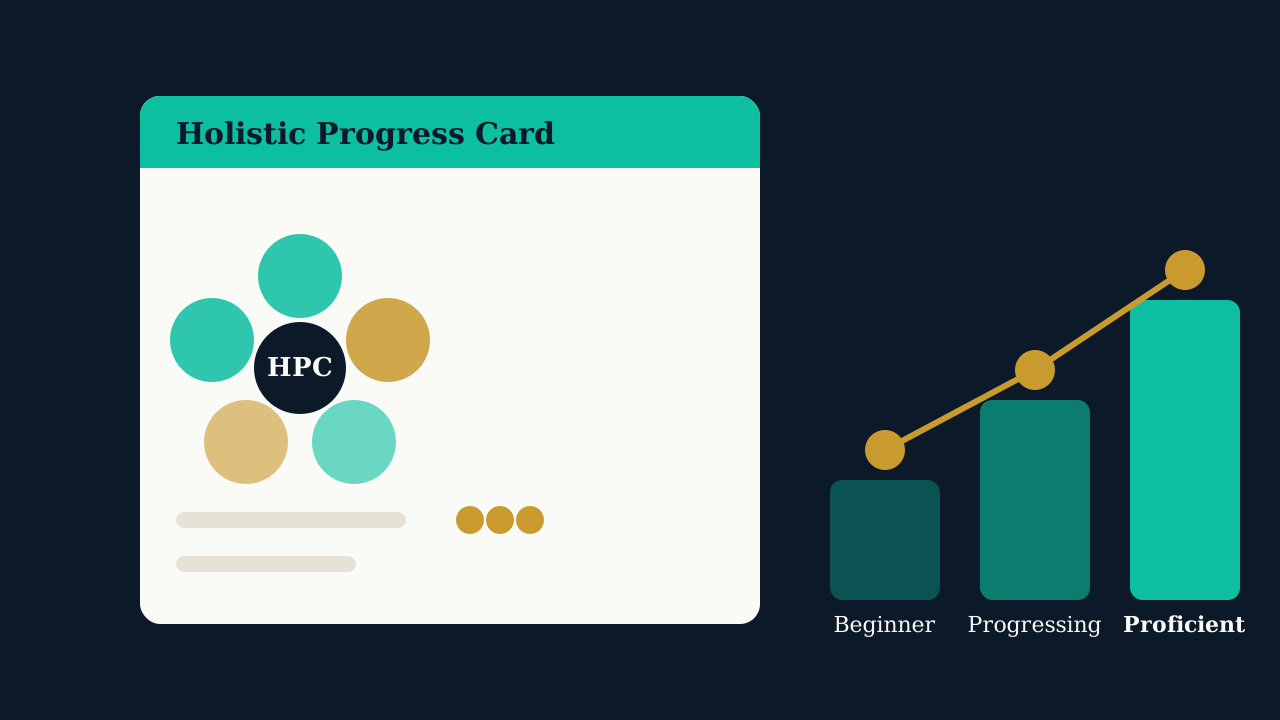
The Holistic Progress Card, or HPC, is CBSE's new report format that replaces a single marks total with a rounded picture of a child across several areas of development. Built by NCERT's assessment body PARAKH and adapted by CBSE, it describes what your child can do, rather than ranking them, and it invites you into the record instead of just handing it over.
What is the Holistic Progress Card (HPC)?
The HPC is, in CBSE's own words, "the record of a child's learning and progress in all domains of learning achievement and development." It comes out of the National Education Policy 2020, whose Para 4.35 calls for a card that gives "a 360 degree, multidimensional report of progress" covering a learner in the cognitive, affective, socio-emotional, and psychomotor domains.
In practice that means the card looks past marks in a subject. At the Foundational Stage it reports across five areas: physical development, socio-emotional and ethical development, cognitive development, language and literacy, and aesthetic and cultural development, plus positive learning habits. Instead of "68 in Maths", you get a description of which specific skills your child has picked up and which are still forming. The card is meant to be, per the CBSE guide, "descriptive and analytic rather than merely numerical."
The design also pulls in voices the old card never had. NEP 2020 asks the HPC to include self-assessment by the child and peer assessment alongside the teacher's judgement, and to be "accompanied by parent-teacher meetings in order to actively involve parents." Your notes about your child at home are meant to sit inside the record, not outside it.
Is the HPC live in CBSE schools right now?
Partly, and it depends on your school and your child's class. CBSE adopted the National Curriculum Framework for the Foundational Stage for all affiliated schools through Circular No. Aff.08/2023 dated 17 March 2023, and PARAKH has published HPC formats for all four stages: Foundational (up to Class 2), Preparatory (Classes 3 to 5), Middle (Classes 6 to 8), and Secondary.
As of July 2026 the rollout is staged rather than switched on everywhere at once. The Foundational Stage came first, with CBSE implementation guides for teachers already out, and the Preparatory and Middle stages following. Crucially, CBSE's guidance is that "the school can adopt or adapt the HPC", so two CBSE schools in the same city may be at different points, and a school may tweak the format to its own context.
The honest takeaway for a parent: do not assume this year's card is an HPC, and do not assume it is not. Ask your school directly which format your child's class is using this session, and whether the reporting is the older grade sheet, a full HPC, or a blend of the two.
What do Beginner, Progressing, and Proficient mean?
Rather than percentages, the Foundational Stage HPC marks each competency at one of three levels of attainment. CBSE defines them like this:
| Level | What it means |
|---|---|
| Beginner | Tries to achieve the competency with a lot of support from the teacher |
| Progressing | Achieves the competency with occasional or some support |
| Proficient | Achieves the competency on their own |
Schools often show these with neutral icons, a flower, a tree, or a smiley, rather than letters, so young children are not ranked against each other. One line in the CBSE teacher guide is worth pinning above the card:
Remember the focus is to assess the task and not the learner.
Read that way, "Beginner" is not a verdict on your child. It is a note that a particular skill still needs an adult alongside it, which is ordinary and expected at this age. A useful question to bring to the teacher is not "why is this a Beginner" but "what does moving this one skill to Progressing look like over the next term?"
What does the HPC ask of parents?
More than the old card did. Because the HPC is designed as "an important link between home and school", the teacher may ask for your observations: how your child plays, what holds their attention, which routines they manage on their own at home. The CBSE guide even asks teachers to "include a narrative on what parental support is needed in a specific domain."
That is a genuine shift. A marks sheet asked nothing of you beyond a signature. The HPC treats you as someone who sees your child in situations the classroom never does, and it expects that picture to feed the record. It helps to arrive at the parent-teacher meeting with your own short notes rather than only questions.
There is a line to hold, though. The HPC and its supporting notes talk about spotting "early signals about possible developmental challenges or learning difficulties." That language belongs to trained teachers observing over time, not to a one-off worry. A progress card, of any kind, cannot screen for a learning or attention difficulty. If you are genuinely concerned about one, that is a conversation for a qualified professional, never a box on a card.
How is the HPC different from the old marks report?
The gap is the whole point. A marks card is a summary written after the fact; the HPC is meant to be gathered continuously, from everyday classroom tasks, so it can catch a wobble while there is still time to act. CBSE frames this as a move from "assessment of learning" towards "assessment for learning and assessment as learning."
It matters because the letter alone often misleads. National data shows how far a grade-level label can sit from a child's actual skill: the ASER 2024 report found only 33.7% of Std III children could solve a basic subtraction problem, and just 30.7% of Std V children could do a simple division sum, both national rural figures. A card that says only "pass" hides exactly which of those two children is sitting in front of you.
The HPC's promise is that the specifics are on the page. Its limit is time: teachers with large classes cannot narrate every skill for every child every week. That is where a parent watching the same skill across their own child's work at home turns a broad card into a concrete plan. The habit behind that is covered in how to read your child's report card.
How can you support the skills the HPC tracks at home?
Start with the card's own logic: pick one skill, watch it across a few pieces of work, and see whether it is steady or still wobbling. LearnAlice was built for exactly that read. It does not teach or tutor. It grades the printed worksheets your child already does and rolls them into a skill picture in your board's own report-card language, so a vague "developing in number work" becomes "steady on addition, still developing on subtraction with borrowing."
That maps neatly onto the HPC's three parent-facing states. Think of every skill as Mastered, Still developing, or Not practised yet, and act only on the middle one, because that is where a little targeted practice pays off. "Not practised yet" is not a gap, so it is never something to worry about.
For the early years the HPC covers first, foundational number sense is the thing to keep warm at home. You can generate a free worksheet on exactly one skill from the Class 2 Maths topics, or browse the whole free worksheet library across every CBSE class and subject if you want a place to begin tonight.
FAQ
Is the Holistic Progress Card compulsory in all CBSE schools?
Not uniformly yet, as of July 2026. CBSE has published HPC formats and implementation guides and schools can adopt or adapt them, starting with the Foundational Stage and extending to Classes 3 to 8. Because rollout is staged and school-led, the surest way to know is to ask your school which format this year's card uses.
What do the HPC levels Beginner, Progressing, and Proficient mean?
They describe how much help a child needs with a skill, not a mark. Beginner means the child attempts the competency with a lot of teacher support, Progressing means with occasional support, and Proficient means on their own. Schools often show them with neutral icons like a flower or tree so young learners are not ranked.
Does the Holistic Progress Card give marks or percentages?
No. At the Foundational Stage the HPC is descriptive and analytic rather than numerical, so it records competencies at attainment levels instead of a marks total. The idea is to show which specific skills are secure and which are still forming, across several areas of development, not to produce a single score to compare children by.
Want the skill behind the card, in your board's own words? Start a 14-day free trial of LearnAlice and turn the worksheets your child already does into a clear read on what to practise next.
Holistic Progress CardCBSE report card
Worksheets are the input. Clarity is the output.
LearnAlice turns every worksheet your child completes into a clear picture of what they've mastered, what's still developing, and the one thing to practise next — in your school board's own language.
Start free trial14 days free per child · no card needed